Nothing publishes without a signature.
For healthcare, finance, and other regulated clients, every piece of content runs through a compliance gate before it goes live: screened against your rulebook, signed off by a named person on your side, and logged permanently. Every other client still gets a real review gate, just a lighter one built for speed instead of audit. Here's exactly how both work.
A claim that ships with no record of who approved it
Volume-first AI content shops can draft fast. What they can't produce is a defensible answer to the question a regulator, a board, or a client's own counsel will eventually ask: who approved this, when, and on exactly what version? Our regulated engine is built to answer that question every time, automatically, not as a manual step someone might forget.
What "approved" actually means here
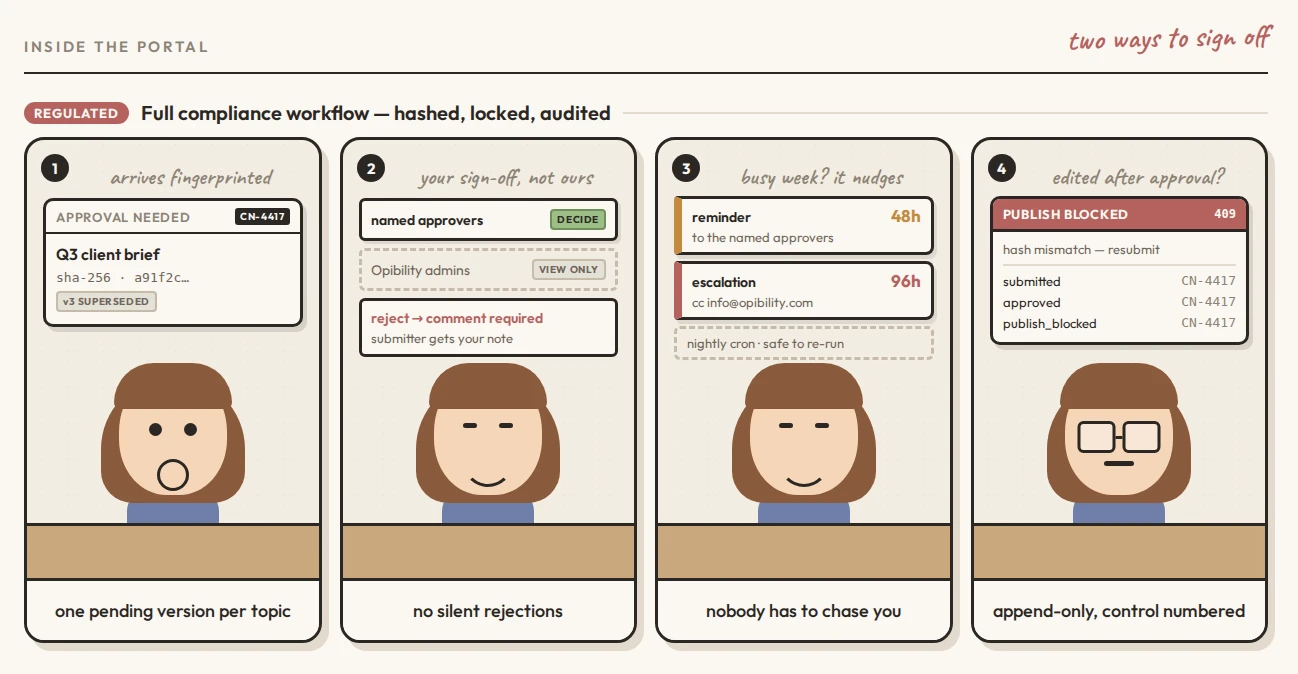
An approver doesn't sign off on a summary or a topic idea. They sign off on the exact, final file. We fingerprint that file the moment it's submitted, and we re-check the fingerprint again immediately before anything goes live. If so much as a character changed in between, publishing is blocked automatically. The approval isn't a rubber stamp on an idea; it's a lock on the actual bytes a reader will see.
Approvals don't happen on our clock, and the system doesn't assume they will
Reviewers are people with other jobs. Our publishing pipeline is built to wait correctly: it checks whether a piece is still awaiting sign-off, and if so, it does nothing. No nagging, no resubmitting, no silent workarounds. If a piece is rejected, the reviewer's note becomes the instruction for the next draft. Automated reminders go out at 48 and 96 hours so nothing quietly stalls, without anyone having to chase it by hand.
Nothing publishes on the reviewer's behalf, ever Not on a deadline, not on a retry, not because a step was skipped. If sign-off hasn't happened, the content simply doesn't go live.
An audit trail you can hand to anyone
Every submission, every approval or rejection, every publish, and every blocked attempt is logged permanently: who, what, and when. It's producible on demand, for your own compliance team, for a regulator, or for counsel. Nothing in the log can be edited after the fact.
Not every client needs a compliance gate, but nobody publishes with zero review
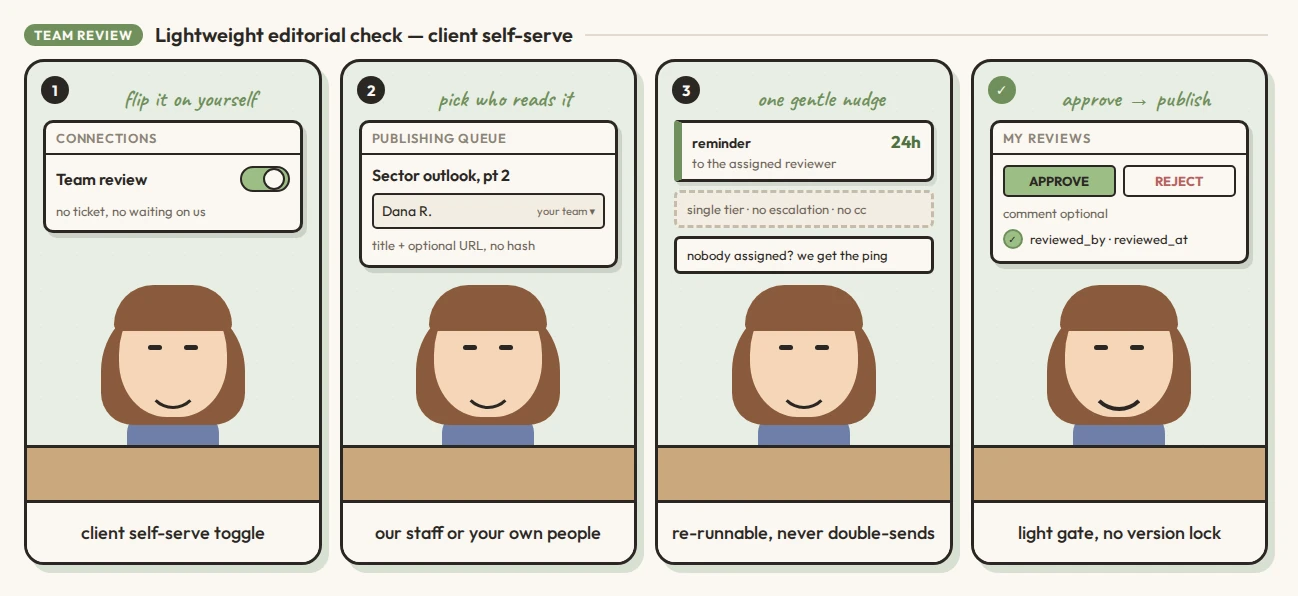
Standard Engine clients get Team Review: a lighter editorial check built for speed, not for an audit trail. You turn it on yourself from the portal, no ticket, no waiting on us. Pick who reads each piece, your own team or ours, and if it sits unassigned we pick it up automatically. One reminder goes out after 24 hours if a review is still pending. A single approve-or-reject click either publishes the piece or sends it back with a note for the next draft. No version hash, no escalation chain, no control numbers. Just a real second set of eyes before anything goes live.
Want to see this against your specific compliance requirements? Talk to us.
This is the gate a volume-first AI vendor can't offer you.
See how it fits your specific compliance requirements, with no obligation, just the roadmap.