Today is Black Friday, Friday, November 27, 2026. Cyber Monday is three days away. Between now and Monday night, most inboxes your audience owns will get more promotional email than at any other point in the year, and most of the senders will respond to that crowd the same way: by sending more.
The volume is not a guess. Sinch, which runs the Mailgun and Mailjet sending platforms, reported delivering 20.4 billion emails during Black Friday week in 2025, with volume on Black Friday itself up about 30% on the year before. Mailchimp's own review of the 2025 season, covering more than 44 billion emails sent through its platform between Halloween and New Year's Eve, found the opposite pattern among the senders who did best: the top 10% of senders by click rate reached about a 10% click rate, against roughly 1.2% for everyone else, while sending around 56 times fewer emails.
That is one platform's data and it shows a correlation, not a cause. Brands with loyal audiences may simply need to send less. But it is a useful corrective on the one weekend when "send another one" feels like the safe move. Yesterday we covered the check to run before the team logs off: links, codes, times, an owner and a pause rule. This post is the other half. It is about what to send at all, to whom, and how to tell on Monday whether it worked.
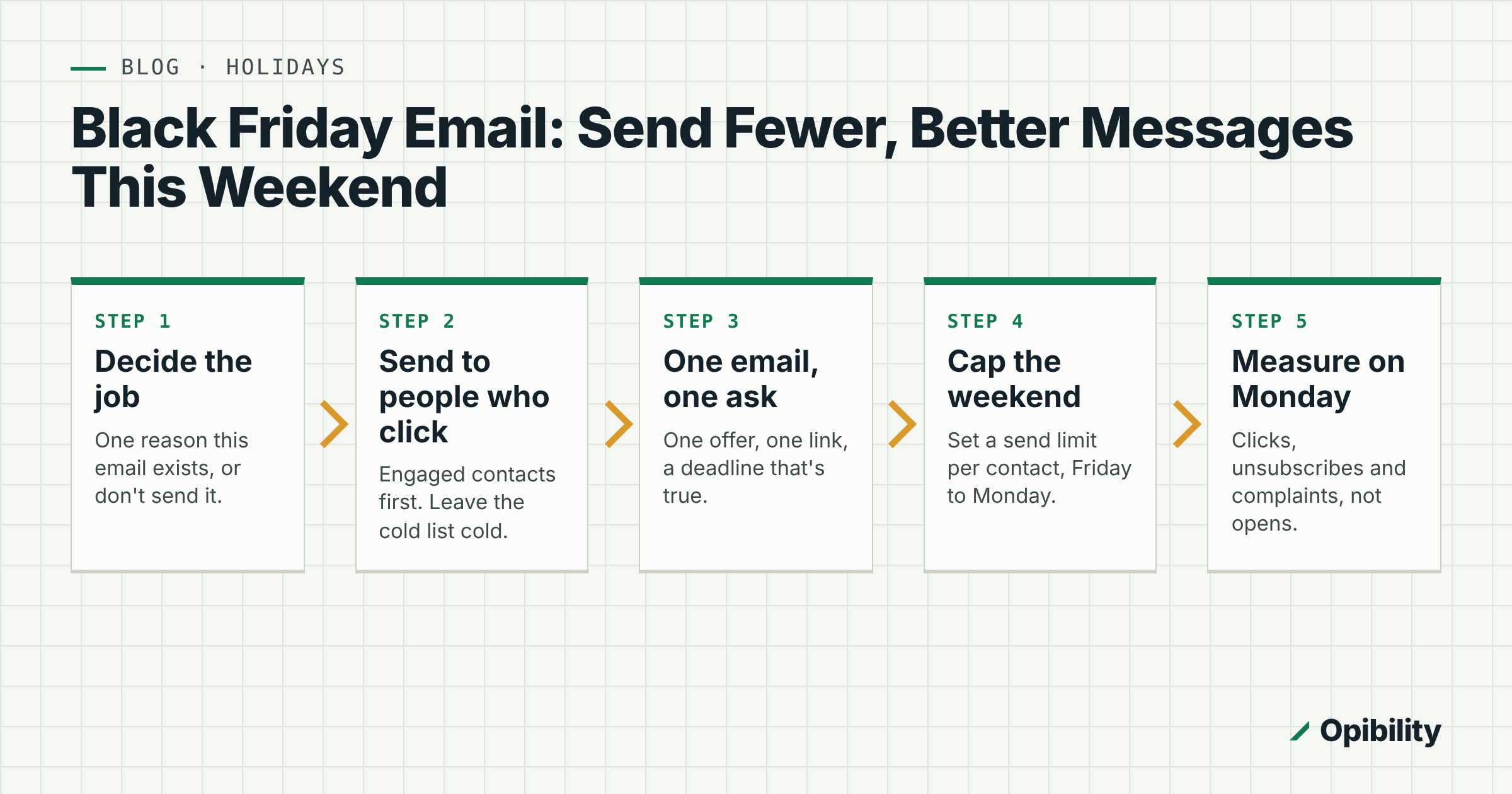
1. Decide what this email is for, or don't send it
Every message on this weekend's schedule should have one job you can say in a sentence: announce a real offer, remind people who showed interest that it ends, or tell customers something they need to know about the holiday period. "We should be in the inbox on Black Friday" is not a job. If your business does not sell anything with a Black Friday price, and many service and B2B businesses do not, you are not obliged to send. A sale you invented to have something to say tends to read exactly like that.
If you are a service business, the honest seasonal angle is usually not a discount. It is the calendar: the year is ending, budgets and plans for January are being set, and some people really are deciding now. An email that says plainly what you can start in January, and how to get on the schedule, is earned. A 20%-off banner on a retainer usually is not.
2. Send to the people who click, and leave the cold list cold
Start from your engaged contacts: people who have clicked, replied, bought or booked in a recent window you can define, such as the last 90 days. Send to them first. Contacts who have not engaged in a year are where spam complaints and unsubscribes come from, and Black Friday is the worst possible weekend to find that out, because your sending reputation carries into December. Gmail's sender guidelines, which we went through in yesterday's post, ask bulk senders to keep the reported spam rate below 0.1%. A cold segment woken up for one promotion is the fastest way to break that.
3. One email, one ask
In a crowded inbox, a message gets a second or two to say what it is. Put the offer, or the point, in the subject line in plain words. Give the email one main link, not five. If there is a deadline, it should be the real one, in a named time zone, and it should match when the offer actually ends. A "last chance" email followed by an extension on Tuesday teaches your list that your deadlines do not mean anything, and that costs you every promotion after this one.
4. Cap the weekend per contact
Individual emails are usually reasonable. The problem is the stack: the Friday launch, the Saturday reminder, the Sunday "still on", the Cyber Monday version, the Monday night last call, plus a newsletter that was already scheduled. Each was approved on its own, and nobody looked at what one person on the list receives in total. Before the weekend goes further, count the sends any single contact will get from Friday to Monday, across every tool, and set a limit. Then decide which messages people who have already bought or booked stop receiving. Thanking someone for an order and then emailing them the same offer twice more is a common, avoidable mistake.
5. Measure on Monday against a normal week, not against opens
Open rates are a weak measure for this weekend. For people who use Apple Mail Privacy Protection, Mail downloads remote content privately in the background when a message arrives, not when it is opened, and Apple says the feature keeps senders from seeing whether a message was opened. Opens from those readers say little about attention. Look at the numbers that reflect a decision: clicks per email sent, conversions or bookings, unsubscribes and spam complaints. Then compare each with an ordinary week, not just with last Black Friday. If a third reminder brought in a handful of clicks and doubled the unsubscribes, that is your answer for next year, and for the December sends you are about to plan.
Write it down while it is fresh. One short note on Tuesday, listing what went out, to whom, what it produced and what it cost in unsubscribes and complaints, is worth more next November than any benchmark report.
The five-minute version
- Can you say in one sentence why each scheduled email exists? If not, cut it.
- Is every send going to engaged contacts first, with the long-cold list left out?
- Does each email have one main ask, one main link, and a deadline that is true?
- Do you know how many emails one contact gets from Friday to Monday, across every tool?
- Do people who already bought or booked stop getting the offer?
- On Monday, are you reading clicks, unsubscribes and complaints against a normal week, and writing it down?
The takeaway
Black Friday rewards attention, not volume. The inbox is at its most crowded, and the senders who come out ahead are the ones whose email is worth opening, not the ones who send most often. Send fewer messages, to the people who want them, each with one clear job, and use Monday's numbers to decide what December looks like.
Sources: Sinch, Black Friday and Cyber Monday 2025 breakdown, and Mailgun's 2025 BFCM analysis (20.4 billion emails delivered across Sinch's platforms in Black Friday week, Black Friday volume up about 30% year over year; vendor platform data); Mailchimp, Breaking Through Peak Season Noise and its 2025 peak-season insights (44 billion+ emails, Halloween to New Year's Eve 2025; top decile by click rate around 10% versus 1.2%, sending about 56 times fewer emails; platform data, correlational); Google, Email sender guidelines; Apple, Use Mail Privacy Protection.