Today is Small Business Saturday, Saturday, November 28, 2026. For a lot of independent shops, restaurants, studios and service businesses, it is the one day of the year when people walk in, or click through, specifically because the business is small and they have not been there before.
American Express, which started the day in 2010, publishes a survey ahead of it each year. Its 2026 Shop Small Impact Study, run by Teneo in September, found that 88% of U.S. consumers said they were likely to shop at a small, independently owned business or restaurant this holiday season, the highest level the study has recorded since 2012. Seventy percent said they get joy from discovering new small businesses during the holidays. On the owner side, 80% said Small Business Saturday can help build customer relationships that last beyond the season.
Those are stated intentions from a survey the organiser of the day commissioned, not sales data, so read them as a mood rather than a forecast. But the shape is useful: the day is about discovery. Much of today's traffic is people meeting you for the first time. Whether that turns into a relationship is mostly decided by a few small, unglamorous pieces of content work, and most of them have to happen today or this week. This is the third post in our holiday-weekend series, after the check to run before the team logs off and sending fewer, better emails on Black Friday.
1. Make today's hours true everywhere people look
A first-time customer does not know your hours. They look them up, usually on a map, and believe what they see. If you are open late today, closed tomorrow, or running a pop-up somewhere else, check that the same answer appears on your Google Business Profile, your website and the bio of whichever social account you post from. On Google, holiday and event changes go in special hours, which leave your regular hours untouched. Google's own help page also recommends confirming hours for official holidays even when they are the same as usual, so customers can see the hours are current. Do this for the rest of December while you are there, not just for today.
2. Ask once for a way to stay in touch, and say what they will get
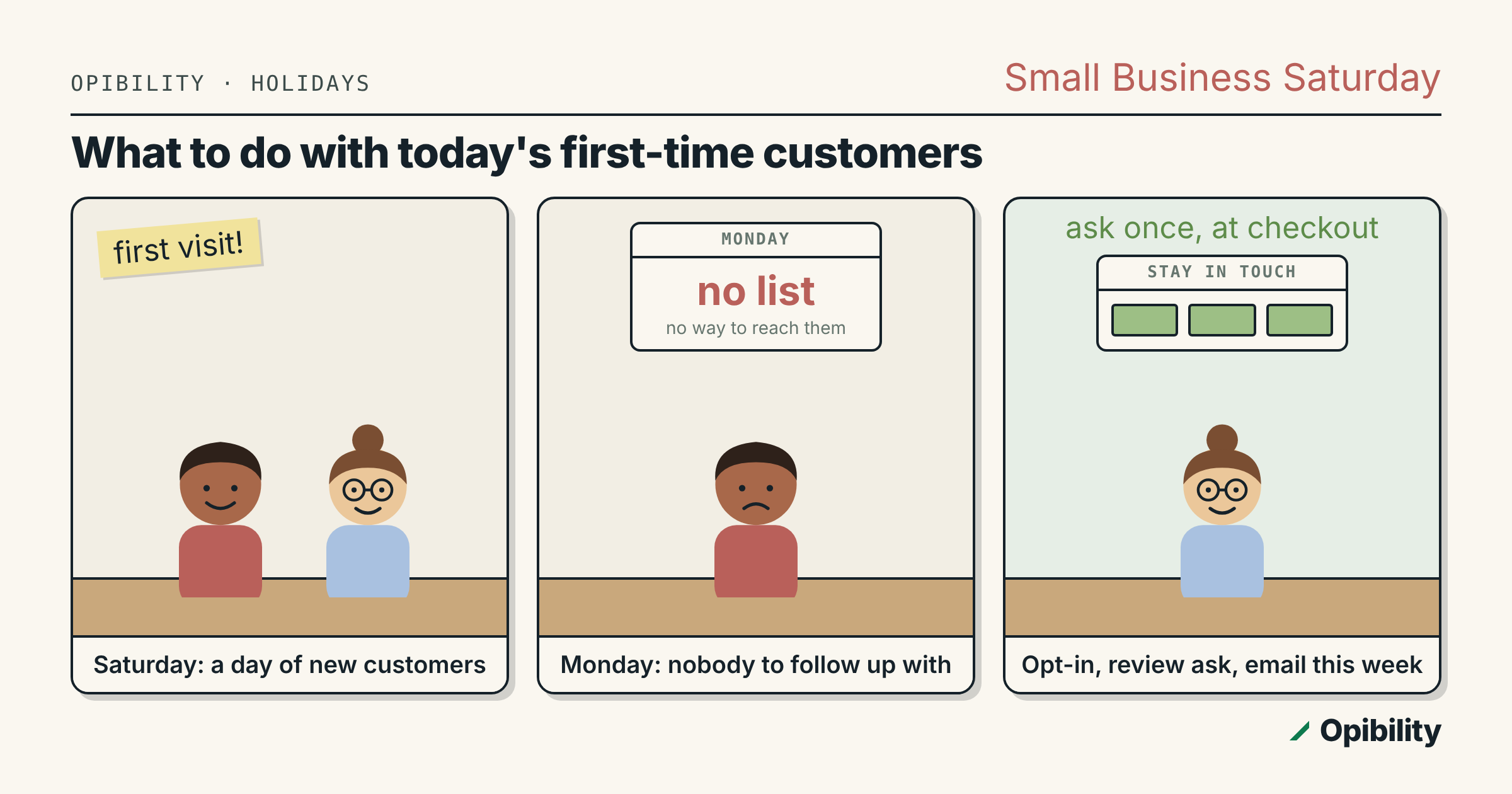
The most common Small Business Saturday mistake is simple: a good day of new customers, and on Monday there is no way to reach any of them. Fix it with one plain ask at the point of sale or on the confirmation page. Tell people exactly what they are signing up for and how often: "One email a month, with new stock and events. Unsubscribe any time." Then send only that.
Keep it to people who said yes. A card number or a receipt email is not permission to market to someone, and contacts who never asked are the ones who report messages as spam. Gmail's sender guidelines ask bulk senders to keep the reported spam rate below 0.1%. A small list of people who chose to hear from you will do more in January than a large one that never agreed to it.
3. Ask every customer for a review, with no reward and no filter
For a business people are discovering, reviews are content: they are what the next new customer reads before deciding to come in. It is fine to ask. What matters is how. Google's Maps content policy bans paying for or incentivising reviews, including with discounts or free goods, and bans selectively soliciting positive reviews from customers. So "leave a five-star review for 10% off" breaks the policy twice, and so does asking only the customers who looked happy. Google says repeated violations can restrict a profile, up to stopping new reviews or unpublishing existing ones for a period. In the U.S., the FTC's 2024 rule on consumer reviews and testimonials also targets buying reviews and suppressing negative ones.
The version that works is boring. Ask everyone the same way, on the receipt, a card by the till or the follow-up email, with a direct link to your profile. Then reply to what comes in, good and bad, in a calm voice. Future customers read the replies as well.
4. Write the follow-up email today, and send it this week
Draft it now, while the day is fresh, so it goes out within a few days rather than in January. One email to new subscribers, with one job: say who you are in two sentences, what is worth coming back for in December, and one link. Add the review link if you did not ask in person. It does not need a discount. A sale is the easiest email to write and the one that teaches new customers to wait for the next sale.
Count it against the rest of the weekend's sends, as we suggested yesterday. Someone who bought from you today and joined your list does not also need Monday's Cyber Monday reminder.
5. Write down what brought people in
Ask "How did you hear about us?" and keep a tally, even if it is a sheet of paper by the till. A map search, a friend, a neighbourhood shopping guide, an Instagram post, a walk past the window. By Monday you will have a small, honest picture of which channels actually bring in new customers, which is more useful for planning January's content than any benchmark. If almost everyone found you on a map, your profile, photos and reviews are where the effort goes. If they came from a local guide or another business, that partnership is worth a post of its own.
The five-minute version
- Do your Google Business Profile, website and social bio show the same hours for today and the rest of December?
- Is there one plain sign-up ask at checkout, saying what people get and how often?
- Are you only emailing people who said yes?
- Are you asking every customer for a review the same way, with no reward and no filtering?
- Is the welcome email drafted today, with one job and one link, and counted against the weekend's other sends?
- Is someone keeping a tally of how new customers heard about you?
The takeaway
Small Business Saturday hands you something no campaign can buy: a day of people choosing to meet you. The sale happens today. The relationship depends on whether they can find accurate hours, whether you asked to stay in touch, how you asked for a review, and whether the first email arrives while they still remember the visit. All four are small jobs, and all four are content.
Sources: American Express, 2026 Shop Small Impact Study results (Teneo online surveys, September 2026, of 1,008 U.S. adults and 503 small business owners or managers; stated intentions, commissioned by American Express); Google Business Profile Help, How to set special hours; Google, Maps prohibited and restricted content (fake engagement); Google, Email sender guidelines; Federal Trade Commission, final rule banning fake reviews and testimonials (August 2024).